MATH 332 — Fall 2026
Bases, Dimension,
and Coordinates
Anton, Rorres, & Kaul §§4.4–4.7
October 9, 2026
Course Map
Course decks
In this deck
Basis (coordinates use the listed order): \(\mathcal{B}=\{1,t,t^2\}\)
\([p]_{\mathcal{B}}=\begin{bmatrix}2\\-3\\5\end{bmatrix}\)
\(p(t)=2\cdot1-3\cdot t+5\cdot t^2\)
Why Span, Bases, and Coordinates?
Which vectors can we build, and how can we describe each one uniquely?
From building vectors to giving them addresses
Choose vectors \(\vct{b}_1,\ldots,\vct{b}_k\) in a space \(V\)
| Concept | Question it answers | Payoff |
|---|---|---|
| Linear combination | What does \(c_1\vct{b}_1+\cdots+c_k\vct{b}_k\) build? | One vector from chosen ingredients |
| Span | What can all choices of coefficients reach? | The attainable subspace |
| Linear independence | Can two coefficient lists build the same vector? | No ambiguity when independent |
| Basis \(\{\vct{b}_1,\ldots,\vct{b}_k\}\) | Do we reach every vector of \(V\), uniquely? | A spanning, independent set |
| Coordinates \(c_1,\ldots,c_k\) | Which coefficients build this vector? | Its address in an ordered basis |
Spanning gives existence; independence gives uniqueness
A square becomes a parallelogram
An invertible map transforms the standard basis into a new basis
\[\begin{gather*} \mat{A}=\begin{bmatrix}2&1\\0&1\end{bmatrix},\qquad \vct{b}_1=\mat{A}\vct{e}_1=\begin{bmatrix}2\\0\end{bmatrix},\qquad \vct{b}_2=\mat{A}\vct{e}_2=\begin{bmatrix}1\\1\end{bmatrix} \end{gather*}\]
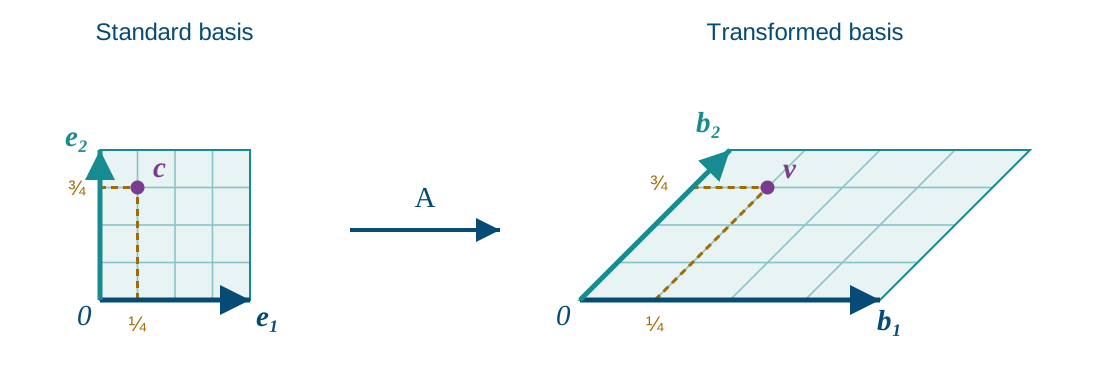
\[ \vct{c}=\begin{bmatrix}1/4\\3/4\end{bmatrix} \quad\longmapsto\quad \vct{v}=\mat{A}\vct{c}=\tfrac14\vct{b}_1+\tfrac34\vct{b}_2 =\begin{bmatrix}5/4\\3/4\end{bmatrix} \]
Unique addresses need independent directions
Keep \(\vct{b}_1=[2,0]^{\mathsf T}\) and \(\vct{b}_2=[1,1]^{\mathsf T}\)
For the ordered basis \(\mathcal{B}=\{\vct{b}_1,\vct{b}_2\}\),
\[ \vct{v}=\begin{bmatrix}5/4\\3/4\end{bmatrix} \quad\text{has coordinates}\quad [\vct{v}]_{\mathcal{B}}=\begin{bmatrix}1/4\\3/4\end{bmatrix} \]
- \(0\le c_1,c_2\le1\) fills the parallelogram; \(c_1,c_2\in\reals\) fills \(\reals^2\)
- \(\det[\vct{b}_1\ \vct{b}_2]=2\ne0\): every vector has one address
- \(\vct{b}_1^{\mathsf T}\vct{b}_2=2\ne0\): a basis need not be orthogonal
\(\exstar\) Add \(\vct{b}_3=\vct{b}_1+\vct{b}_2\) Does the span grow? Find two different lists in \(\vct{b}_3=c_1\vct{b}_1+c_2\vct{b}_2+c_3\vct{b}_3\); zero coefficients are allowed
Coordinates turn transformations into matrix multiplication
Differentiation is a linear transformation \(D:\mathbb{P}_3\to\mathbb{P}_2\), \(D(p)=p'\)
\[ \text{Input basis: }\mathcal{B}=\{1,t,t^2,t^3\},\qquad \text{output basis: }\mathcal{C}=\{1,t,t^2\} \]
For \(p(t)=2-3t+5t^2+4t^3\), transform its coordinates:
\[ \underbrace{\begin{bmatrix}0&1&0&0\\0&0&2&0\\0&0&0&3\end{bmatrix}}_{\mat{M}} \underbrace{\begin{bmatrix}2\\-3\\5\\4\end{bmatrix}}_{[p]_{\mathcal{B}}} =\underbrace{\begin{bmatrix}-3\\10\\12\end{bmatrix}}_{[D(p)]_{\mathcal{C}}} \]
Reconstruct only when needed: \(D(p)(t)=-3+10t+12t^2\)
For a linear map \(T\) and fixed ordered bases: \([T(\vct{v})]_{\mathcal{C}}=\mat{M}[\vct{v}]_{\mathcal{B}}\)
Build \(\mat{M}\) once; compute with coordinates — Matrix Spaces and Rank
Regression chooses the closest vector we can build
\(\mat{A}\in\reals^{m\times n}\): \(m\) observations, \(n\) feature columns \(\vct{A}_1,\ldots,\vct{A}_n\); \(\vct{b}\in\reals^m\): observed responses
\[ \widehat{\vct{b}}=\mat{A}\widehat{\vct{x}} =\widehat{x}_1\vct{A}_1+\cdots+\widehat{x}_n\vct{A}_n \]
- Span: \(S=\operatorname{span}\{\vct{A}_1,\ldots,\vct{A}_n\}\) contains every possible fitted response
- Closest fit: choose \(\widehat{\vct{b}}\in S\) minimizing \(\|\vct{b}-\widehat{\vct{b}}\|^2\)
- Independent columns: \(\operatorname{rank}(\mat{A})=n\), called full column rank
- Basis and coordinates: the ordered columns form a basis of \(S\); \(\widehat{\vct{x}}\) gives the fitted vector’s coordinates
The closest fitted vector is unique; its coefficients are unique exactly when the columns are independent
Example: two features give coordinates for three fitted responses
Fit a line \(b\approx x_1+x_2t\) to \((t,b)=(0,1),(1,0),(2,2)\)
\[ \mat{A}=\begin{bmatrix}1&0\\1&1\\1&2\end{bmatrix},\qquad \vct{b}=\begin{bmatrix}1\\0\\2\end{bmatrix},\qquad \widehat{\vct{x}}=\begin{bmatrix}1/2\\1/2\end{bmatrix} \]
\[ \widehat{\vct{b}}=\tfrac12\begin{bmatrix}1\\1\\1\end{bmatrix} +\tfrac12\begin{bmatrix}0\\1\\2\end{bmatrix} =\begin{bmatrix}1/2\\1\\3/2\end{bmatrix},\qquad \vct{b}-\widehat{\vct{b}}=\begin{bmatrix}1/2\\-1\\1/2\end{bmatrix} \]
The independent feature columns span a plane in \(\reals^3\)
The residual is perpendicular to both columns: this is the closest fit
\([1/2,1/2]^{\mathsf T}\) locates the fitted response in that plane; it does not represent the observed response outside the plane
PCA chooses coordinates adapted to the data
Principal component analysis (PCA): center the data, then choose orthogonal unit directions with the greatest remaining variation
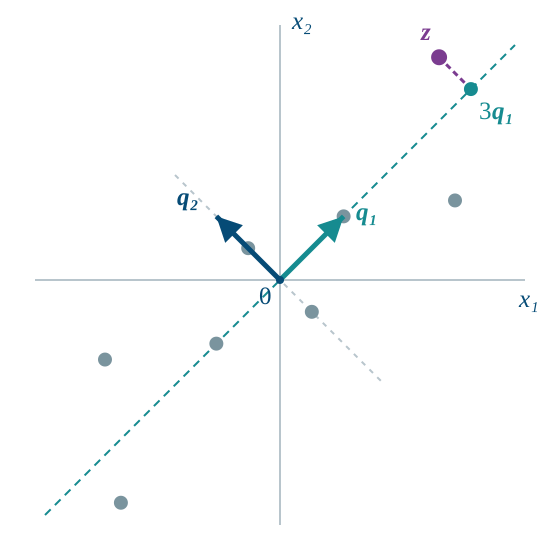
\[ \vct{q}_1=\frac1{\sqrt2}\begin{bmatrix}1\\1\end{bmatrix},\qquad \vct{q}_2=\frac1{\sqrt2}\begin{bmatrix}-1\\1\end{bmatrix} \]
In this basis, one centered observation is
\[ \vct{z}=3\vct{q}_1+\tfrac12\vct{q}_2 \]
Its coordinate vector \([3,1/2]^{\mathsf T}\) contains its scores
Full basis: exact coordinates
Keep \(\vct{q}_1\): \(\vct{z}\approx3\vct{q}_1\) in its span
Independence and Bases
Independence means the zero vector has one construction
Vectors \(\vct{v}_1,\ldots,\vct{v}_k\) are linearly independent when
\[ c_1\vct{v}_1+\cdots+c_k\vct{v}_k=\vct{0} \]
forces
\[ c_1=\cdots=c_k=0 \]
They are linearly dependent when some nonzero coefficient vector produces the zero vector
Independence means no generator can be synthesized from the others
Example: independent Fourier modes
Are \(1\) and \(e^{2\pi\sqrt{-1}\,t}\) independent over \(\mathbb{C}\) on \([0,1]\)?
Suppose \(a+be^{2\pi\sqrt{-1}\,t}=0\) for every \(t\in[0,1]\)
\[ \begin{array}{rcl} t=0&:&a+b=0\\ t=\tfrac12&:&a-b=0 \end{array} \quad\implies\quad a=b=0 \]
Only the trivial combination gives the zero function, so the two modes are independent
Are two Fourier modes independent?
\(\exstar\) Are \(e^{2\pi\sqrt{-1}\,t}\) and \(e^{-2\pi\sqrt{-1}\,t}\) linearly independent over \(\mathbb{C}\) on \([0,1]\)? Set their linear combination equal to zero for every \(t\); evaluate at \(t=0\) and \(t=\tfrac14\) Repeat for \(1\) and \(e^{4\pi\sqrt{-1}\,t}\), choosing two useful values of \(t\)
A homogeneous coefficient system detects independence
For coordinate vectors, place the candidates into columns:
\[ \mat{V}= \begin{bmatrix} \vct{v}_1&\cdots&\vct{v}_k \end{bmatrix} \]
Then
\[ c_1\vct{v}_1+\cdots+c_k\vct{v}_k=\vct{0} \quad\Longleftrightarrow\quad \mat{V}\vct{c}=\vct{0} \]
Only \(\vct{c}=\vct{0}\) solves this system exactly when every column has a pivot
The familiar homogeneous system answers the abstract independence question
Dependence identifies a redundant generator
Suppose
\[ c_1\vct{v}_1+\cdots+c_k\vct{v}_k=\vct{0} \]
and \(c_j\ne0\). Then
\[ \vct{v}_j =-\sum_{i\ne j}\frac{c_i}{c_j}\vct{v}_i \]
Removing \(\vct{v}_j\) does not change the span
A dependence relation is a certificate of redundancy
Bases and Unique Representations
A basis balances reach and economy
A finite set
\[ \mathcal{B}=\{\vct{b}_1,\ldots,\vct{b}_n\} \]
is a basis for \(V\) when
- \(\mathcal{B}\) spans \(V\)
- \(\mathcal{B}\) is linearly independent
For coordinates, use the basis vectors in the order listed
Spanning guarantees existence of coefficients
Independence guarantees uniqueness of coefficients
Every vector has one coefficient list in a chosen ordered basis
Independence makes coordinates unique
Let \(\mathcal{B}=\{\vct{b}_1,\ldots,\vct{b}_n\}\) span \(V\) and be independent
Spanning supplies coefficients; suppose one vector has two coefficient lists
\[ \vct{v}=\sum_{j=1}^n c_j\vct{b}_j =\sum_{j=1}^n d_j\vct{b}_j \]
Subtract the two representations
\[ \sum_{j=1}^n(c_j-d_j)\vct{b}_j=\vct{0} \quad\implies\quad c_j-d_j=0\quad\text{for every }j \]
Linear independence forces the two coefficient lists to agree
A space can have many bases
Coordinates are unique once the ordered basis is fixed
Elimination extracts a basis from a spanning set
The retained vectors must span the same space and be independent
For vectors in \(\reals^m\):
- place the spanning vectors into the columns of a matrix
- row reduce
- identify the pivot columns
- keep the corresponding columns of the original matrix
Row operations preserve dependence relations among columns but change the columns themselves
Use the reduced matrix to locate pivots; take the basis vectors from the original matrix
Example: remove redundant generators
Let \(W\) be the span of the columns of \(\mat{V}\)
\[ \mat{V}=[\vct{v}_1\ \vct{v}_2\ \vct{v}_3\ \vct{v}_4] =\begin{bmatrix}1&0&1&2\\0&1&1&0\\1&1&2&2\end{bmatrix} \;\xrightarrow{R_3\leftarrow R_3-R_1-R_2}\; \begin{bmatrix}1&0&1&2\\0&1&1&0\\0&0&0&0\end{bmatrix} \]
The first two columns are pivot columns
\[ \vct{v}_3=\vct{v}_1+\vct{v}_2, \qquad \vct{v}_4=2\vct{v}_1 \]
Remove \(\vct{v}_3\) and \(\vct{v}_4\) without changing the span
\[ W=\operatorname{span}\{\vct{v}_1,\vct{v}_2,\vct{v}_3,\vct{v}_4\} =\operatorname{span}\{\vct{v}_1,\vct{v}_2\} \]
\(\mathcal{B}=\{\vct{v}_1,\vct{v}_2\}\) still spans \(W\)
\(a\vct{v}_1+b\vct{v}_2=\vct{0}\) forces \(a=b=0\): independence completes the basis proof
Different bases can describe the same span
Use the preceding generators of the plane \(W=\{[x,y,z]^{\mathsf T}:z=x+y\}\)
\[ \vct{v}_1=\begin{bmatrix}1\\0\\1\end{bmatrix},\quad \vct{v}_2=\begin{bmatrix}0\\1\\1\end{bmatrix},\quad \vct{v}_3=\begin{bmatrix}1\\1\\2\end{bmatrix},\quad \vct{v}_4=\begin{bmatrix}2\\0\\2\end{bmatrix} \]
\(\exstar\) A basis must span \(W\) and be independent Show that \(\{\vct{v}_2,\vct{v}_3\}\) is another basis for \(W\) Explain why \(\{\vct{v}_1,\vct{v}_4\}\) is not a basis for \(W\)
A frame can keep redundant generators
For a subspace of \(\reals^n\), a finite spanning list is a frame
Independence is optional; for \(W=\{[x,y,z]^{\mathsf T}:z=x+y\}\), use
\[ \vct{v}_1=[1,0,1]^{\mathsf T},\quad \vct{v}_2=[0,1,1]^{\mathsf T}, \quad \vct{v}_3=\vct{v}_1+\vct{v}_2,\quad \vct{v}_4=2\vct{v}_1 \]
\[ \vct{v}_3 =0\vct{v}_1+0\vct{v}_2+1\vct{v}_3+0\vct{v}_4 =1\vct{v}_1+1\vct{v}_2+0\vct{v}_3+0\vct{v}_4 \]
A redundant frame admits more than one coefficient list for the same vector
Here any one of the four vectors can be lost without losing the span
Bases need not be finite
An algebraic (Hamel) basis uses only finite linear combinations
- All polynomials have a countably infinite basis \(\{1,t,t^2,\ldots\}\)
- Finite Fourier sums on \([0,1]\), over \(\mathbb{C}\), have a countable basis \(\{e^{2\pi\sqrt{-1}\,kt}:k\in\mathbb{Z}\}\)
- \(C(\reals)\), all continuous real-valued functions on the real line, has an uncountable algebraic basis
Algebraic bases give exact finite representations
Countable orthonormal bases in \(L^2[a,b]\) allow infinite expansions
Coordinates in a Chosen Basis
A basis gives every vector unique coordinates
A basis \(\mathcal{B}=\{\vct{b}_1,\ldots,\vct{b}_n\}\) spans \(V\) and is independent
For \(\vct{v}\in V\), spanning gives existence and independence gives uniqueness:
\[ \vct{v}=c_1\vct{b}_1+\cdots+c_n\vct{b}_n \]
The coordinate vector of \(\vct{v}\) relative to \(\mathcal{B}\) is
\[ [\vct{v}]_{\mathcal{B}} =\begin{bmatrix}c_1\\\vdots\\c_n\end{bmatrix} \]
For coordinates, the listed order matters: entry \(j\) multiplies \(\vct{b}_j\)
We have been using the standard basis
In \(\reals^2\), the standard basis is
\[ \mathcal{E}=\left\{\vct{e}_1=\begin{bmatrix}1\\0\end{bmatrix}, \vct{e}_2=\begin{bmatrix}0\\1\end{bmatrix}\right\} \]
Writing \(\vct{x}=\begin{bmatrix}5\\1\end{bmatrix}\) has meant
\[ \vct{x}=5\vct{e}_1+1\vct{e}_2, \qquad [\vct{x}]_{\mathcal{E}}=\begin{bmatrix}5\\1\end{bmatrix} \]
In \(\reals^n\), use \(\mathcal{E}=\{\vct{e}_1,\ldots,\vct{e}_n\}\), where \(\vct{e}_j\) has a 1 in entry \(j\) and zeros elsewhere
Our familiar vector column is its coordinate vector in the standard basis
Same vector, different coordinate columns
For \(\vct{x}=[5,1]^{\mathsf T}\), compare the standard basis \(\mathcal{E}=\{[1,0]^{\mathsf T},[0,1]^{\mathsf T}\}\) with
\[ \mathcal{B}=\left\{\vct{b}_1=\begin{bmatrix}1\\1\end{bmatrix}, \vct{b}_2=\begin{bmatrix}1\\-1\end{bmatrix}\right\} \]
The same vector has two descriptions:
\[ \vct{x}=5\vct{e}_1+1\vct{e}_2=3\vct{b}_1+2\vct{b}_2 \]
\[ [\vct{x}]_{\mathcal{E}}=\begin{bmatrix}5\\1\end{bmatrix}, \qquad [\vct{x}]_{\mathcal{B}}=\begin{bmatrix}3\\2\end{bmatrix} \]
The brackets mean “coordinates of this vector in this basis”
The entries 3 and 2 are weights on \(\vct{b}_1\) and \(\vct{b}_2\), not the standard horizontal and vertical components
The vector stays at \((5,1)\); changing the basis changes its description
Read the basis label before the numbers
Use \(\mathcal{E}=\{[1,0]^{\mathsf T},[0,1]^{\mathsf T}\}\) and \(\mathcal{B}=\{[1,1]^{\mathsf T},[1,-1]^{\mathsf T}\}\)
\(\exstar\) Interpret each coordinate column If \([\vct{u}]_{\mathcal{B}}=[1,0]^{\mathsf T}\), find \(\vct{u}\) in standard coordinates If \([\vct{v}]_{\mathcal{E}}=[1,0]^{\mathsf T}\), find \(\vct{v}\). Is it the same vector as \(\vct{u}\)? Reverse the listed order of \(\mathcal{B}\) to get \(\mathcal{B}'\). Find \([\vct{x}]_{\mathcal{B}'}\) for \(\vct{x}=[5,1]^{\mathsf T}\)
Polynomial coefficients are coordinates in a chosen basis
For the standard polynomial basis
\[ \mathcal{E}=\{1,t,t^2\} \]
the polynomial \(p(t)=2-3t+5t^2\) has coordinates
\[ [p]_{\mathcal{E}} =\begin{bmatrix}2\\-3\\5\end{bmatrix} \]
For another basis, the same polynomial has another coordinate vector
Choosing a basis converts abstract vectors into coordinate columns
Example: a basis of symmetric matrices
For real symmetric \(2\times2\) matrices (\(\mat{A}^{\mathsf T}=\mat{A}\)), use
\[ \mat{B}_1=\begin{bmatrix}1&0\\0&0\end{bmatrix}, \quad \mat{B}_2=\begin{bmatrix}0&1\\1&0\end{bmatrix}, \quad \mat{B}_3=\begin{bmatrix}0&0\\0&1\end{bmatrix} \]
Every symmetric matrix has exactly one representation
\[ \begin{bmatrix}a&b\\b&d\end{bmatrix} =a\mat{B}_1+b\mat{B}_2+d\mat{B}_3 \]
Thus \(\mathcal{B}=\{\mat{B}_1,\mat{B}_2,\mat{B}_3\}\) spans the space and is independent
\[ \mat{A}=\begin{bmatrix}2&-1\\-1&3\end{bmatrix} \quad\implies\quad [\mat{A}]_{\mathcal{B}}=\begin{bmatrix}2\\-1\\3\end{bmatrix} \]
The vector is a matrix; its coordinate vector is a column of coefficients
Bases for other matrix spaces
\(\exstar\) For real \(2\times2\) matrices, build bases from the freely chosen entries Find an ordered basis for all upper-triangular \(2\times2\) matrices In your basis, find the coordinates of \(\begin{bmatrix}2&-1\\0&3\end{bmatrix}\) Find a basis for the skew-symmetric matrices: \(\mat{A}^{\mathsf T}=-\mat{A}\) Explain why your lists both span and are independent
Example: test a polynomial basis
In \(\mathbb{P}_2\), the polynomials in \(t\) of degree at most two, take \(\mathcal{E}=\{1,t,1+t^2\}\)
Its coefficient columns relative to \(\{1,t,t^2\}\) form
\[ \begin{bmatrix}1&0&1\\0&1&0\\0&0&1\end{bmatrix} \]
Three pivots: every coefficient vector is reached uniquely, so \(\mathcal{E}\) spans \(\mathbb{P}_2\) and is independent
For \(p(t)=2+4t+3t^2\),
\[ p=-1(1)+4t+3(1+t^2), \qquad [p]_{\mathcal{E}}=[-1,4,3]^{\mathsf T} \]
A basis question combines two tests
In \(\mathbb{P}_2\), consider
\[ \mathcal{B}=\{1+t,\ t+t^2,\ 1+t^2\} \]
\(\exstar\) Does \(\mathcal{B}\) span all of \(\mathbb{P}_2\) and is it independent? Form the matrix of coefficients relative to \(\{1,t,t^2\}\) Test its columns for independence If it is a basis, find \([2+4t]_{\mathcal{B}}\)
Two more polynomial basis tests
In \(\mathbb{P}_2\), consider
\[ \mathcal{C}=\{1+t,\ t+t^2,\ 1+2t+t^2\}, \qquad \mathcal{D}=\{1+t,\ t+t^2,\ 1\} \]
\(\exstar\) Use spanning and independence to decide which list is a basis of \(\mathbb{P}_2\) For the basis, find the coordinates of \(2+4t\)
Dimension and Coordinates
Dimension counts vectors in any basis
A space is finite-dimensional if it has a finite basis
Every basis then has the same number of vectors, the dimension:
\[ \dim(V)=n \]
Over \(\reals\): columns, one-variable polynomials of degree at most \(k\), and matrices
\[ \dim(\reals^n)=n, \qquad \dim(\mathbb{P}_k)=k+1, \qquad \dim(\reals^{m\times n})=mn \]
Our earlier \(U=\{p\in\mathbb{P}_3:p(0)=0\}\) has basis \(\{t,t^2,t^3\}\), so \(\dim(U)=3\)
The zero space has the empty basis, so \(\dim(\{\vct{0}\})=0\)
Dimension counts independent directions, not the number of vectors in the space
Dimension turns two tests into one
Suppose \(\dim(V)=n\) and a list contains exactly \(n\) vectors in \(V\)
Then either one of these facts proves the other:
\[ \text{linearly independent} \quad\Longleftrightarrow\quad \text{spans }V \]
More generally,
- more than \(n\) vectors must be dependent
- fewer than \(n\) vectors cannot span \(V\)
- every independent list can be extended to a basis
- every spanning list can be reduced to a basis
Knowing the dimension can cut a basis proof in half
Use dimension before computing
Since \(\dim(\mathbb{P}_3)=4\):
\(\exstar\) What can the dimension alone tell you? Can three polynomials span \(\mathbb{P}_3\)? Can five polynomials be linearly independent in \(\mathbb{P}_3\)? If four polynomials are independent, what else follows?
Dimension depends on the scalar field
The same set \(\mathbb{C}\) can be viewed as two different vector spaces
| Scalars | A basis | Dimension |
|---|---|---|
| \(\mathbb{C}\) | \(\{1\}\) | \(\dim_{\mathbb{C}}(\mathbb{C})=1\) |
| \(\reals\) | \(\{1,\sqrt{-1}\}\) | \(\dim_{\reals}(\mathbb{C})=2\) |
Over \(\mathbb{C}\), any \(z\) is the scalar multiple \(z\cdot1\)
Over \(\reals\), write \(z=a+b\sqrt{-1}\) with two real coefficients
\(\exstar\) Find the dimensions of \(\mathbb{C}^2\) over \(\mathbb{C}\) and over \(\reals\)
Example: count monomials to find dimension
In \(\mathbb{P}_2(\reals^2)\), total degree is at most two: add the \(x\) and \(y\) exponents
\[ \underbrace{1}_{0}, \qquad \underbrace{x,\ y}_{1}, \qquad \underbrace{x^2,\ xy,\ y^2}_{2} \]
Every polynomial in the space is a unique linear combination of these six monomials
They form a basis, so
\[ \dim(\mathbb{P}_2(\reals^2))=1+2+3=6 \]
Count freely chosen coefficients after identifying a basis
Dimension beyond coordinate columns
\(\exstar\) Find a basis and count its vectors; total degree adds the \(x\) and \(y\) exponents \(\mathbb{P}_3(\reals^2)\): list monomials by total degree All upper-triangular \(3\times3\) matrices All symmetric \(3\times3\) matrices Could five symmetric \(3\times3\) matrices span their entire space?
Arithmetic in Coordinates
The coordinate map preserves linear combinations
For a basis \(\mathcal{B}\) of an \(n\)-dimensional real vector space, define
\[ \vct{v}\longmapsto[\vct{v}]_{\mathcal{B}}\in\reals^n \]
The column \([\vct{v}]_{\mathcal{B}}\) lists coefficients in this ordered basis, so
\[ [c\vct{u}+d\vct{v}]_{\mathcal{B}} =c[\vct{u}]_{\mathcal{B}}+d[\vct{v}]_{\mathcal{B}} \]
The coordinate map is one-to-one, onto, and preserves linear combinations
Such a map is a linear isomorphism
It preserves linear combinations; ordinary coordinate lengths may change
Every \(n\)-dimensional real vector space has the same linear structure as \(\reals^n\)
Example: combine coordinate vectors
Use the polynomial basis \(\mathcal{B}=\{1,1+t,t^2\}\)
\[ p=2+3t+t^2, \quad [p]_{\mathcal{B}}=[-1,3,1]^{\mathsf T} \]
\[ q=1-t+2t^2, \quad [q]_{\mathcal{B}}=[2,-1,2]^{\mathsf T} \]
Compute in coordinates:
\[ [2p-q]_{\mathcal{B}} =2[-1,3,1]^{\mathsf T}-[2,-1,2]^{\mathsf T} =[-4,7,0]^{\mathsf T} \]
Reconstruct: \(-4(1)+7(1+t)+0t^2=3+7t=2p-q\)
Coordinate arithmetic uses coefficients in the chosen basis
Reconstruct after coordinate arithmetic
Keep \(\mathcal{B}=\{1,1+t,t^2\}\) and suppose
\[ [p]_{\mathcal{B}}=[1,2,-1]^{\mathsf T}, \qquad [q]_{\mathcal{B}}=[-2,1,3]^{\mathsf T} \]
\(\exstar\) Coordinate entries multiply \(1\), \(1+t\), and \(t^2\) in that order Find \([p+2q]_{\mathcal{B}}\) without first expanding the polynomials Reconstruct \(p+2q\) as a polynomial in \(t\) Why is its constant coefficient different from the first coordinate?
Changing Coordinate Systems
- A basis matrix converts coordinates to standard form
- Change of basis passes through the vector
- Transition columns describe the old basis in the new one
- Example: change between polynomial bases
The companion notebook explores basis extraction and coordinate changes
A basis matrix converts coordinates to standard form
For a basis \(\mathcal{B}=\{\vct{b}_1,\ldots,\vct{b}_n\}\) of \(\reals^n\), form
\[ \mat{P}_{\mathcal{B}} =\begin{bmatrix}\vct{b}_1&\cdots&\vct{b}_n\end{bmatrix} \]
The column \([\vct{x}]_{\mathcal{B}}\) lists coefficients multiplying these basis vectors
Independence makes \(\mat{P}_{\mathcal{B}}\) invertible:
\[ \vct{x}=\mat{P}_{\mathcal{B}}[\vct{x}]_{\mathcal{B}}, \qquad [\vct{x}]_{\mathcal{B}}=\mat{P}_{\mathcal{B}}^{-1}\vct{x} \]
The columns of a basis matrix tell what the new coordinate axes mean in standard coordinates
Change of basis passes through the vector
Let \(\mathcal{B}\) and \(\mathcal{C}\) be ordered bases of \(\reals^n\)
\(\mat{P}_{\mathcal{B}}\) and \(\mat{P}_{\mathcal{C}}\) contain their basis vectors as columns
\[ \vct{x}=\mat{P}_{\mathcal{B}}[\vct{x}]_{\mathcal{B}} =\mat{P}_{\mathcal{C}}[\vct{x}]_{\mathcal{C}} \]
To obtain \(\mathcal{C}\)-coordinates, multiply by \(\mat{P}_{\mathcal{C}}^{-1}\):
\[ [\vct{x}]_{\mathcal{C}} =\underbrace{\mat{P}_{\mathcal{C}}^{-1}\mat{P}_{\mathcal{B}}}_{ \text{transition from }\mathcal{B}\text{ to }\mathcal{C}} [\vct{x}]_{\mathcal{B}} \]
Changing coordinates changes the description, not the vector
Transition columns describe the old basis in the new one
Let \(\mathcal{B}=\{\vct{b}_1,\ldots,\vct{b}_n\}\) and \(\mathcal{C}\) be ordered bases of the same finite-dimensional real vector space
\[ \mat{Q}_{\mathcal{C}\leftarrow\mathcal{B}} =\begin{bmatrix}[\vct{b}_1]_{\mathcal{C}}&\cdots&[\vct{b}_n]_{\mathcal{C}}\end{bmatrix} \]
Column \([\vct{b}_j]_{\mathcal{C}}\) lists the coefficients that rebuild \(\vct{b}_j\) from \(\mathcal{C}\)
\[ [\vct{v}]_{\mathcal{C}} =\mat{Q}_{\mathcal{C}\leftarrow\mathcal{B}}[\vct{v}]_{\mathcal{B}} \]
For bases of \(\reals^n\), this is \(\mat{P}_{\mathcal{C}}^{-1}\mat{P}_{\mathcal{B}}\)
The arrow records the direction: input coordinates in \(\mathcal{B}\), output coordinates in \(\mathcal{C}\)
Example: change between polynomial bases
In \(\mathbb{P}_2\), choose
\[ \mathcal{B}=\{1,1+t,t^2\},\qquad \mathcal{C}=\{1,t,t+t^2\} \]
Columns give \(\mathcal{C}\)-coefficients of the \(\mathcal{B}\) polynomials; use \(t^2=(t+t^2)-t\):
\[ \mat{Q}_{\mathcal{C}\leftarrow\mathcal{B}} =\begin{bmatrix}1&1&0\\0&1&-1\\0&0&1\end{bmatrix} \]
For \(p=2-3t+5t^2\),
\[ [p]_{\mathcal{B}}=\begin{bmatrix}5\\-3\\5\end{bmatrix} \quad\xrightarrow{\mat{Q}_{\mathcal{C}\leftarrow\mathcal{B}}}\quad [p]_{\mathcal{C}}=\begin{bmatrix}2\\-8\\5\end{bmatrix} \]
\(2(1)-8t+5(t+t^2)=p\): new coordinates, same polynomial
Coordinates change with the basis
Keep \(\vct{x}=[5,1]^{\mathsf T}\) and compare
\[ \mathcal{C}=\bigl\{[1,0]^{\mathsf T},[1,1]^{\mathsf T}\bigr\}, \qquad \mathcal{D}=\bigl\{[2,1]^{\mathsf T},[1,1]^{\mathsf T}\bigr\} \]
\(\exstar\) Find \([\vct{x}]_{\mathcal{C}}\) and \([\vct{x}]_{\mathcal{D}}\) Reconstruct \(\vct{x}\) from each coordinate vector Use basis vectors as columns of \(\mat{P}_{\mathcal{C}}\) and \(\mat{P}_{\mathcal{D}}\); check the change from \(\mathcal{C}\) to \(\mathcal{D}\) with \(\mat{P}_{\mathcal{D}}^{-1}\mat{P}_{\mathcal{C}}\)
Big Ideas
- Independence means every vector has at most one construction from the generators
- A basis combines independence and spanning to give unique coordinates
- Coordinates are coefficients in an ordered basis; the same vector can have different coordinate columns
- Dimension counts basis vectors and depends on the scalar field
- Coordinate maps preserve linear structure; transition matrices change descriptions
How Far We Have Come
- Systems and Matrices — \([\,\mat{A}\mid\vct{b}\,]\) tests consistency and finds free parameters; PLU saves elimination
- Matrix actions — products compose, inverses undo; determinants give signed scale and detect collapse
- Euclidean Spaces — consistent solutions: \(\vct{x}_p+\operatorname{null}(\mat{A})\); dot products, projection, and 3D cross products describe geometry
- Vector Spaces and Span — subspaces contain all linear combinations; vectors can be matrices, polynomials, or functions
- Bases and Coordinates — spanning gives coefficients; independence makes them unique; dimension counts basis vectors
- Coordinates — ordered-basis coordinates preserve linear combinations; changing the basis changes the column, not the vector
With ordered basis \(\mathcal{B}=\{\vct{b}_1,\ldots,\vct{b}_d\}\) and \(d=\dim(V)<\infty\): \(\vct{v}=\sum_{j=1}^d c_j\vct{b}_j\) has unique coordinates \([\vct{v}]_{\mathcal{B}}=[c_1,\ldots,c_d]^{\mathsf T}\)
What Comes Next
How do bases and dimension expose the structure of a matrix?
© 2026 Fred J. Hickernell · Illinois Tech · assisted by ChatGPT and Codex · Bases and Coordinates · MATH 332 — Fall 2026 Website · \(\exstar\) = exercise